Investing for beginners means putting money into financial assets such as stocks, bonds, or funds to build wealth over time, and accepting in exchange that their value can fall. That risk is the price of returns that savings accounts cannot match. Those returns have averaged about 7–10% a year for broad equity indices such as the S&P 500 and the MSCI World Index over multi-decade periods, with no guarantee for any single year. For a beginner, the usual start is a low-cost index fund or ETF, bought through a regulated platform and topped up every month.
Saving keeps money safe up to the limit of a deposit guarantee, but money held at low interest rates loses purchasing power to inflation every year. Trading aims at short-term price movements and asks for different knowledge, tools, and time. Investing holds assets for years or decades, and those years let compound interest work. A ₹1,00,000 investment growing at 7% a year reaches about ₹7,60,000 after 30 years, because each year’s gains earn returns of their own.
A beginner can lose part or all of the amount invested, because the same markets that grow money can also shrink it. In the 2008 financial crisis, the S&P 500 fell about 57% from peak to trough. The risks a beginner meets first are market risk, liquidity risk, and concentration risk. A beginner puts three prerequisites in place before the first rupee goes in: an emergency fund covering 3–6 months of expenses, high-interest debt under control, and a time horizon of at least five years.
Once the prerequisites are in place, a beginner chooses what to buy. Passive investing tracks a market index instead of picking stocks, and it is the default for a beginner because over 15-year periods roughly 85–90% of actively managed large-cap funds fail to beat their benchmark. The six main investment types are stocks, bonds, ETFs, mutual funds, index funds, and robo-advisors, and crypto stays a speculative asset outside them. The index fund suits a first investment because it holds hundreds or thousands of companies in a single purchase. Its cost still counts, because trading commissions, the total expense ratio (TER), the bid-ask spread, and custody fees compound against returns over decades.
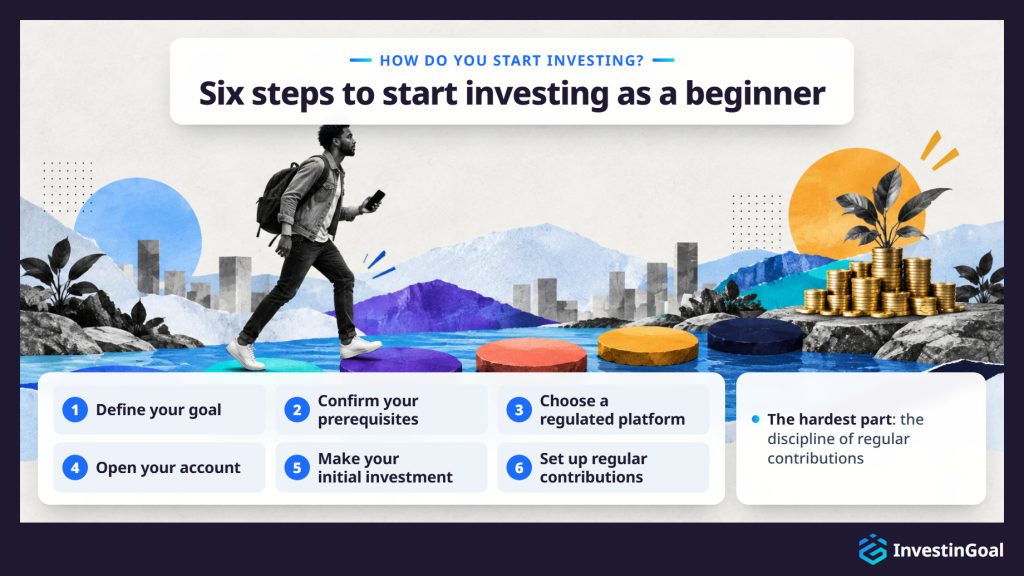
Getting started follows six steps: define a goal, confirm the prerequisites, choose a regulated platform, open an account, make the initial investment, and automate regular contributions. The amount is a smaller barrier than most beginners assume, because many platforms accept ₹100 and ₹5,000 a month is enough to build a diversified position. Beginners most often go wrong by timing the market, selling in a panic during a drop, investing without an emergency fund, concentrating capital in one asset, and ignoring fees. An index fund guards against concentration, because it delivers diversification automatically.
An investment plan ties the steps together through five elements: a financial goal, a time horizon, an honest assessment of risk tolerance, an asset allocation, and a monitoring schedule. The plan runs on two strategies that need few decisions: passive index investing and rupee-cost averaging, which invests a fixed amount at regular intervals. The money stays invested for at least five years, because shorter windows expose investors to a much wider range of outcomes. It sits in a brokerage account with a regulated broker or platform, and a beginner chooses the platform on regulation first, then on products, fees, minimum deposit, and usability.
What’s your main goal in reading this guide?
Choose one — see how your answer compares with other readers.
What Is the Definition of Investing?
Investing is the act of allocating money into financial assets, such as stocks, bonds, or funds, with the expectation of generating returns and building wealth over time. Unlike spending or saving, investing means accepting the possibility of loss in exchange for the opportunity to grow the original capital.
The distinction matters because it sets the relationship between risk and reward behind every investment decision. When you invest, you gain market exposure. The value of your assets moves with the markets they are tied to. That exposure is what creates the potential for growth, but it is also what makes loss possible. Putting capital into financial assets is a deliberate decision to pursue returns that saving alone cannot deliver.
Investing differs from saving primarily in risk and return. Money held in a regulated savings account carries no market risk and is typically deposit-guaranteed up to a defined limit, while invested money is exposed to market fluctuations and can fall below the original amount.
A savings account protects your capital in nominal terms. In India, the Deposit Insurance and Credit Guarantee Corporation (DICGC) covers up to ₹5 lakh per depositor per bank. The trade-off is that the interest rate on savings accounts is usually low, and in many periods it sits below the rate of inflation. That means the money is safe in absolute terms but loses purchasing power over time. For example, ₹10,00,000 will buy less in ten years than it buys today unless its growth at least matches inflation.
Investing reverses the trade-off of the savings account. There is no deposit guarantee on market-exposed assets, and the value of your holdings can drop. But the potential return over longer periods is substantially higher, which is why investing exists as a distinct financial tool. For a beginner, the useful question is which money belongs in savings and which in investments. Short-term needs and emergency reserves belong in savings accounts and other accounts that protect capital. Money you will not need for five years or more is where investing becomes appropriate.
Investing differs from trading in time horizon and intent. Investors hold assets for years or decades to build wealth gradually, while traders buy and sell frequently, sometimes within a single day, to profit from short-term price movements.
Long-term investing and active trading require different knowledge, different tools, and different time commitments. A buy-and-hold investor who buys a diversified index fund and contributes monthly needs no market monitoring beyond a quarterly review. A trader who buys and sells individual positions daily needs real-time data, technical analysis skills, and the ability to manage leveraged risk. The two activities share a financial system but diverge in almost every practical dimension, and investing differs from trading in ways that determine which skills, costs, and risk tolerances apply to each.
Why Should People Start Investing?
People should start investing because savings accounts alone do not keep pace with inflation over time. Money held at low interest rates loses purchasing power each year, while invested capital has the potential to grow and compound across decades. Historically, broad equity indices such as the S&P 500 and the MSCI World Index have delivered average annual returns of approximately 7–10% over multi-decade periods, a rate that savings accounts have rarely matched.
If inflation runs at 2–3% per year and your savings earn 1%, you are losing ground in real terms every year you wait. Over 20 or 30 years, that gap becomes enormous. Protecting money from loss is not enough to build long-term wealth. Long-term wealth needs money at work, growing faster than the cost of living.
The 7–10% annual figure for historical equity returns refers to broad, diversified market indices measured over periods of 20 years or more. It is not a guarantee, and individual years can produce negative results. But the long-run pattern is the reason that investing, rather than saving alone, is the standard recommendation for building wealth over time. The earlier you begin, the more years compound interest has to work, and the less you need to contribute in total to reach the same outcome.

Filippo Ucchino
Co-Founder and CEO of InvestinGoal - Introducing Broker
What is your main reason for wanting to invest?
Choose one — see how your answer compares with other readers.
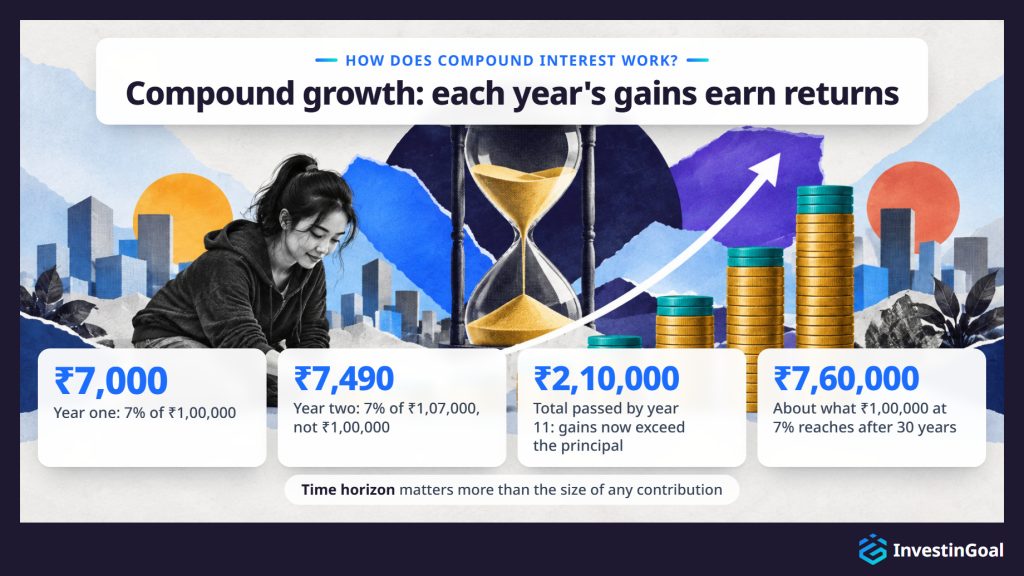
Compound interest works by reinvesting returns so that each subsequent period generates gains not only on the original amount, but on all previously accumulated growth. In equity investing, the mechanism is more precisely called compound growth or compounding returns, since the growth rate varies year to year rather than being fixed as with a savings account, but the principle is identical. A ₹1,00,000 investment growing at 7% per year does not simply add ₹7,000 each year. It reaches approximately ₹7,60,000 after 30 years, because each year’s gains are added to the base and generate their own returns in the following period.
The year-by-year breakdown shows how compound interest works. In year one, 7% of ₹1,00,000 produces ₹7,000. In year two, 7% applies to ₹1,07,000, not ₹1,00,000, producing ₹7,490. The difference seems small early on, but the acceleration is exponential. By year 11, the gains added together are larger than the original principal, and the total has passed ₹2,10,000. By year 30, the total is more than seven times what you started with, even though you added nothing after the initial contribution.
Time horizon matters more than the size of any single contribution. Starting five years earlier with a modest amount produces a larger final sum than starting later with a larger amount, because the early money has more cycles of compounding ahead of it. This is the single most concrete reason to begin investing as soon as the three prerequisites are in place, and it is why time is the most powerful variable a beginner can control.
What Are the Main Risks of Investing for Beginners?
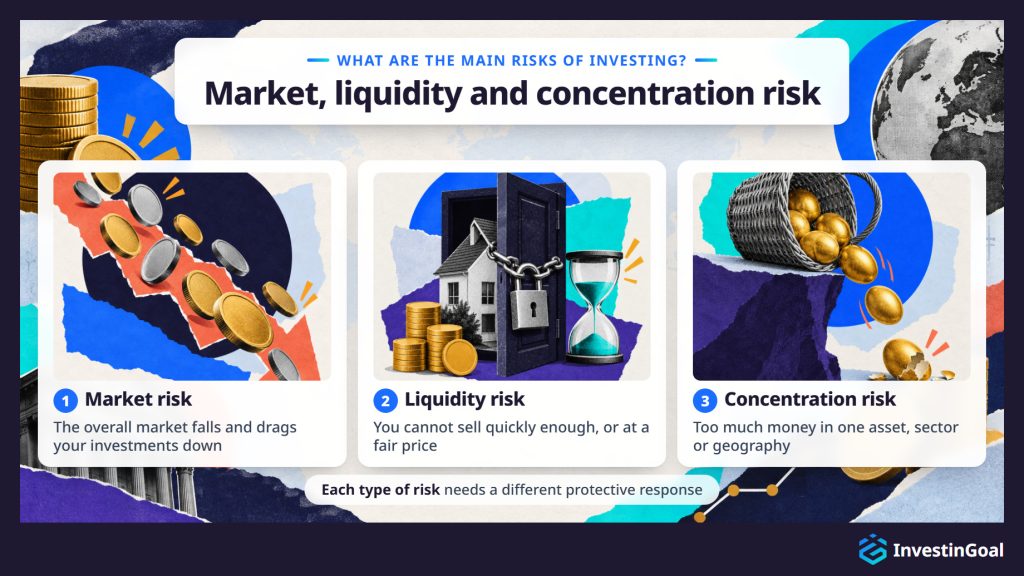
Beginners face several distinct categories of investment risk, the most important being market risk, liquidity risk, and concentration risk. Each type requires a different protective response, so a beginner needs to understand all three before allocating capital.
Market risk is the possibility that the overall market declines in value, dragging your investments down with it, regardless of their individual quality. This is the most visible form of volatility, and it is the one beginners encounter first. An investor cannot eliminate market risk, only manage it through diversification and time.
Liquidity risk is the possibility that you cannot sell an asset quickly enough, or at a fair price, when you need to. Liquidity is high for most publicly traded stocks and ETFs and can be low for other assets, such as certain bonds, property investments, or niche funds.
Concentration risk is the possibility that too much of your money is in a single asset, sector, or geography. If that one position drops, the effect on your total portfolio is disproportionate. Diversification is the direct countermeasure.
Market risk, liquidity risk, and concentration risk decide whether a beginner’s first investing experience ends in avoidable capital loss or in a sustainable, long-term position. Standard deviation and Value at Risk go one step further into the risks of investing, because they measure how much volatility a portfolio carries.
Yes, you can lose money investing, including the full amount you put in. There is no guarantee of positive returns on market-exposed investments, and both the invested capital and any accumulated gains can fall in value, particularly over short holding periods or when assets are concentrated in a single position.
Capital loss is a normal feature of market-based investing. During the 2008 global financial crisis, the S&P 500 fell approximately 57% from peak to trough while European indices such as the EURO STOXX 50 declined by a comparable magnitude. In the 2020 COVID-19 crash, global markets dropped over 30% in a matter of weeks before recovering. Individual stocks can lose most or all of their value at any time.
Markets recovered both times. The S&P 500 took about four years to climb from its 2009 low back to its 2007 peak, and about five months from its March 2020 low. The reason investing still makes sense over time is that historically, diversified portfolios held for long periods have recovered from declines and continued to grow, but that statistical pattern does not protect any individual investor who needs to sell during a fall.
Invested money does not carry a deposit guarantee. When your principal is at risk, the amount you started with can shrink. This is fundamentally different from a savings account, and it is the reason to put the prerequisites, diversification, and time horizon in place before starting.
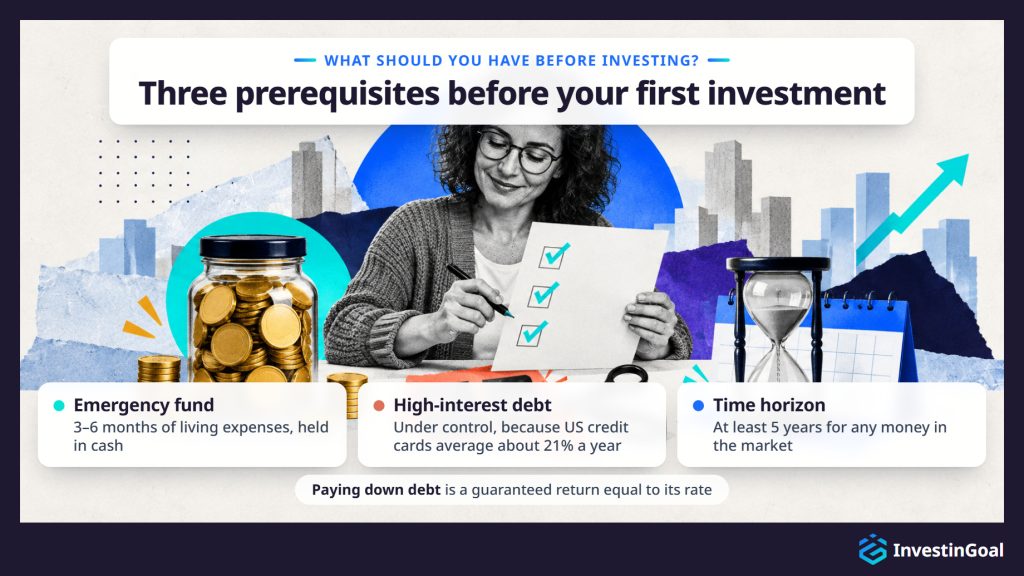
Before you start investing, you should have three prerequisites in place: a cash emergency fund covering 3–6 months of living expenses, the elimination or control of high-interest debt (whose cost typically exceeds realistic investment returns), and a defined time horizon of at least 5 years for any money placed in market-exposed assets.
The emergency fund is a cash buffer that ensures you never need to sell investments at a loss to cover an unexpected expense. Without it, a job loss, medical bill, or major repair forces a liquidation that may lock in losses. The 3–6 month threshold is a widely accepted benchmark because it covers the average time needed to find new employment or recover from a significant unplanned cost.
In some countries, like the US, credit card balances carry an average interest rate of about 21% a year, according to the Federal Reserve. No realistic investment strategy reliably outperforms that cost. Paying down this debt is, in effect, a guaranteed return equal to the interest rate you eliminate. A mortgage and other lower-interest debt do not necessarily need clearing first, but the same principle applies. The debt takes priority whenever its cost exceeds the expected return on the investment.
The five-year minimum time horizon is the third prerequisite. Money you may need within the next one to four years should not be in market-exposed assets, because short-term fluctuations can mean selling at a loss. Only money you can genuinely leave untouched for five years or more belongs in an investment account.
What Is the Difference Between Active and Passive Investing?
Active investing differs from passive investing in how an investor chooses the portfolio and how costs accumulate. Active investing involves selecting individual securities or timing the market in pursuit of returns that exceed a benchmark, while passive investing tracks a market index and accepts average market returns in exchange for lower costs and less management effort.
In practice, active investing means either picking individual stocks yourself or paying a fund manager to do it. The goal is to beat the market, but the effort costs higher management fees, research time, and transaction costs, and that cost compounds against you just as returns compound for you. Over long periods, the majority of actively managed funds have underperformed their benchmark index after fees. The SPIVA Scorecard, published by S&P Global across US, European, and UK markets, consistently shows that over 15-year periods, roughly 85–90% of actively managed large-cap funds fail to beat their benchmark.
Passive investing accepts the market’s return by design. Instead of trying to pick winners, a passive investor buys a fund that holds the same assets as a broad market index, in the same proportions. The investor makes few decisions, the fees are low, and the return closely mirrors the market’s overall performance. For a beginner, passive investing is the default starting point because it requires discipline rather than expertise and delivers broad diversification automatically. What makes the passive approach the practical default is the gap between active and passive investing in costs and long-run results.
What Types of Investments Can Beginners Choose From?
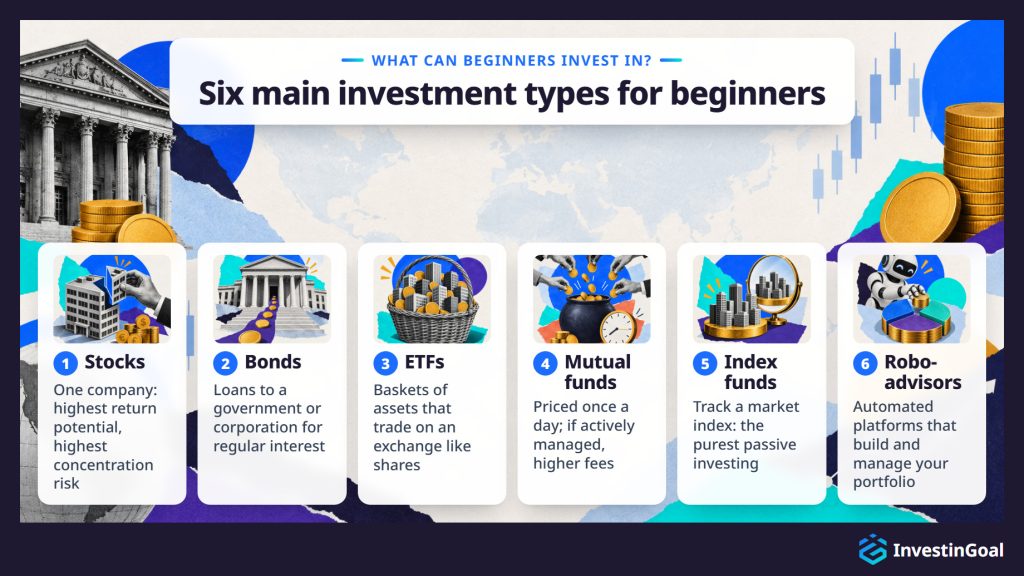
Beginners have access to six main investment types, each with a different risk profile, entry point, and management requirement: stocks, bonds, ETFs, mutual funds, index funds, and robo-advisors. Beyond these six, cryptocurrency is an additional option with a substantially higher risk profile, and it is not a typical starting point for complete beginners.
- Stocks represent ownership in a single company. When the company grows in value, the stock price tends to rise. When it struggles, the price falls. Stocks offer the highest individual return potential but also the highest concentration risk if you hold only one or a few positions.
- Bonds are loans you make to a government or corporation in exchange for regular interest payments and the return of your capital at maturity. They are generally less volatile than stocks but offer lower long-term returns.
- ETFs (exchange-traded funds) are baskets of assets that trade on a stock exchange like individual shares. A single ETF can hold hundreds or thousands of stocks or bonds, delivering instant diversification at low cost.
- Mutual funds operate on a similar principle but are priced once per day and may be actively managed, which typically means higher fees.
- Index funds track a specific market index, whether they are ETFs or mutual funds, and are the purest expression of passive investing.
- Robo-advisors are automated platforms that build and manage a diversified portfolio on your behalf based on your risk tolerance and goals. Services such as Scripbox in India charge a small management fee but remove the need to select individual funds yourself.
Crypto sits outside these categories. It is highly volatile, regulated in the EU only since the MiCA rules of December 2024, and lacks the historical return data that supports long-term equity investing. A beginner should treat it as a speculative asset rather than a core investment building block. Each asset class responds differently to market conditions, carries a different cost structure, and suits a different risk profile, so the full range of investment types is worth knowing before committing capital to any single one.
For a complete beginner, the best first investment is typically a diversified, low-cost index fund or ETF, because it provides immediate exposure to a broad basket of assets, requires no stock selection, and keeps costs low. The right choice for each person depends on three criteria: cost (expressed as the fund’s total expense ratio, or TER), diversification breadth, and the investor’s ability to hold through short-term price drops without selling.
A global index fund or ETF that tracks a broad market index gives a beginner exposure to hundreds or thousands of companies in a single purchase. In Europe, widely held examples include the Vanguard FTSE All-World UCITS ETF (VWCE) at a TER of 0.14% and the iShares Core MSCI World UCITS ETF at 0.20%. In the US, the Vanguard Total Stock Market ETF (VTI) charges just 0.03%. The TER on such funds is typically between 0.03% and 0.25% per year, which means the cost of holding them is negligible relative to the long-term growth they provide access to.
The three criteria are straightforward. First, the fund should be low-cost, because every fraction of a per cent in fees compounds against your returns over decades. Second, it should be broadly diversified, because a fund holding the entire market is inherently safer than one concentrated in a single sector or country. Third, and most importantly, the beginner must be prepared to hold the position through periods of decline. With a good first investment, the single biggest risk is the investor selling it at a loss during a temporary downturn.
What’s the main thing stopping you from investing right now?
Choose one — see how your answer compares with other readers.
What Are the Costs When You Invest?
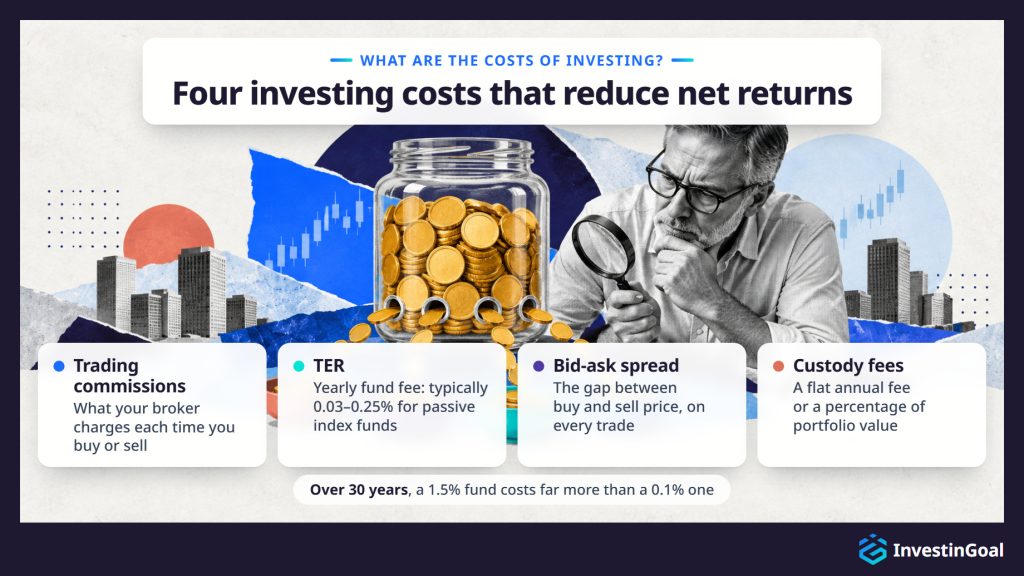
Investing involves several layers of cost that directly reduce net returns: broker trading commissions, fund management fees expressed as the total expense ratio (TER or expense ratio), the bid-ask spread on each transaction, and annual platform custody fees. Most beginners underestimate all four.
- Trading commissions are what your broker charges each time you buy or sell an asset. Many platforms have reduced or eliminated these for standard trades, but they still exist on some platforms and for certain asset types.
- The TER is the annual percentage fee a fund charges for managing its assets. For a passive index fund, this is typically 0.03–0.25%. For an actively managed fund, it can be 0.5–1.5% or more. The difference may seem small in a single year, but over decades it compounds significantly.
- The bid-ask spread is the small gap between the price at which you can buy an asset and the price at which you can sell it. It is a transaction cost that exists on every trade, and it is larger for less liquid assets.
- Custody fees are charged by some platforms for holding your assets. They may be a flat annual fee or a percentage of your portfolio value.
Costs compound against you with the same mathematical force that returns compound for you. A fund charging 1.5% per year will, over 30 years, consume a far larger share of your total wealth than a fund charging 0.1%. The difference in final portfolio value between a high-cost and a low-cost fund can amount to millions of rupees, even when both earn the same gross return. Even a 1% annual cost difference compounds across a 20–30 year horizon, so the costs of investing are worth checking before choosing any product.
How Do You Start Investing as a Beginner?
To start investing as a beginner, the first step is to define a clear financial goal and confirm that the three prerequisites are in place: an emergency fund, a manageable debt position, and a time horizon of at least 5 years. From there, the process moves through choosing a regulated platform, opening an account, selecting an initial investment aligned with your risk tolerance, and setting up a regular contribution schedule.
- Define your goal. Are you investing for retirement in 25 years, for a home deposit in 7 years, or for general long-term wealth building? The goal determines the time horizon, which determines the appropriate level of risk.
- Confirm your prerequisites. You need 3–6 months of expenses in cash, no uncontrolled high-interest debt, and confidence that you will not need the money you plan to invest for at least five years.
- Choose a regulated platform. Select a broker or investment platform that is authorised by a recognised financial regulator in your country. The platform should offer the investment products you need (at minimum, low-cost index funds or ETFs), charge transparent fees, and have a functional, usable interface.
- Open your account. This is typically an online process that takes 10–30 minutes and requires identity verification. You will need a government-issued ID and proof of address.
- Make your initial investment. For most beginners, this means buying a diversified, low-cost index fund or ETF. Start with an amount you are comfortable with, even if it is small.
- Set up regular contributions. Automate a monthly transfer into your investment account and a recurring purchase of your chosen fund. This removes the temptation to time the market and builds your position steadily over time.
The process is simpler than most beginners expect. The hardest part is the discipline of maintaining regular contributions and resisting the urge to react to short-term market movements. The specific steps vary by country, because regulatory requirements, available platforms, and tax treatment differ across jurisdictions. Those differences shape every stage of how to start investing, from the choice of platform to the tax on gains.
Many regulated platforms allow investors to start with as little as ₹100 through fractional share programmes, and a regular contribution of ₹5,000 per month is sufficient to begin building a diversified position in index funds or ETFs. In practice, platforms have removed the capital barrier almost entirely. Interactive Brokers has no minimum deposit and offers fractional shares. The minimum investment amount matters far less than the discipline of starting consistently. Platform minimums vary, but the barrier is lower than most beginners assume.
The misconception that investing requires hundreds of thousands of rupees upfront is one of the most common reasons people delay. In practice, the cost of a single share of a global index ETF is often between ₹500 and ₹10,000, and fractional shares remove even that constraint. Regular contributions over time matter more than the size of the first deposit. A person who contributes ₹5,000 per month for 30 years accumulates significantly more at a 7% annual return than someone who waits five years and then invests ₹5,00,000 as a lump sum.
Compound interest rewards time in the market more than the size of any single transaction. The platform also shapes the money you need to start investing, because minimum deposits and fees differ from one platform to another.
The most common investing mistakes beginners make are: trying to time the market, selling during short-term price drops out of panic selling, investing before an emergency fund is in place, concentrating all capital in a single asset or sector (concentration risk), and ignoring fees when choosing a platform or fund.
Market timing is the belief that you can predict when prices will rise or fall and buy or sell accordingly. Market timing fails even for professional fund managers, as decades of research show. For a beginner, the attempt typically results in buying after prices have already risen and selling after they have already fallen, which is the opposite of what produces returns.
Panic selling is the behavioural cousin of market timing. When markets drop 10–20%, the instinct to sell and protect what remains is powerful, but acting on it locks in losses that would otherwise be temporary. The remedy is structural as well as emotional. With an adequate emergency fund and a long time horizon, you do not need the invested money now, and the decline is a short-term event within a long-term trajectory.
Investing without an emergency fund turns every unexpected expense into a forced sale. Skipping the emergency fund is the single structural error most likely to turn a temporary market decline into a permanent loss.
Concentration risk and ignoring fees are quieter mistakes but equally damaging over time. Holding a single stock exposes you to company-specific failure. Choosing a fund with a 1.5% TER over one with 0.1% costs millions of rupees over a 30-year period, even when both give the same market exposure. Buy-and-hold discipline, broad diversification, and cost awareness are the three habits that prevent the majority of beginner errors.
Diversification reduces the damage a single investment’s poor performance can do to the overall portfolio. When you spread capital across different assets, sectors, or geographies, stability or gains in one area partly offset losses in another. For a beginner, diversification is the most accessible form of risk management, because index funds and ETFs deliver it automatically without requiring individual stock selection.
Diversification rests on correlation. Correlation measures how closely two assets move in the same direction at the same time, and not all assets move together. When technology stocks decline, healthcare or consumer staples may hold steady or rise. When one country’s market underperforms, another’s may outperform. By holding a broad basket of assets, you reduce single-stock risk and smooth the overall return path of your portfolio.
For a beginner, the practical implication is straightforward. A single global index fund holds thousands of companies across dozens of countries. Buying it achieves a level of diversification that would be impossible to replicate by purchasing individual stocks, and it does so at minimal cost. The index fund therefore gives a beginner a protection against losses that would otherwise take significant expertise and capital to build by hand.
What Should an Investment Plan Include?
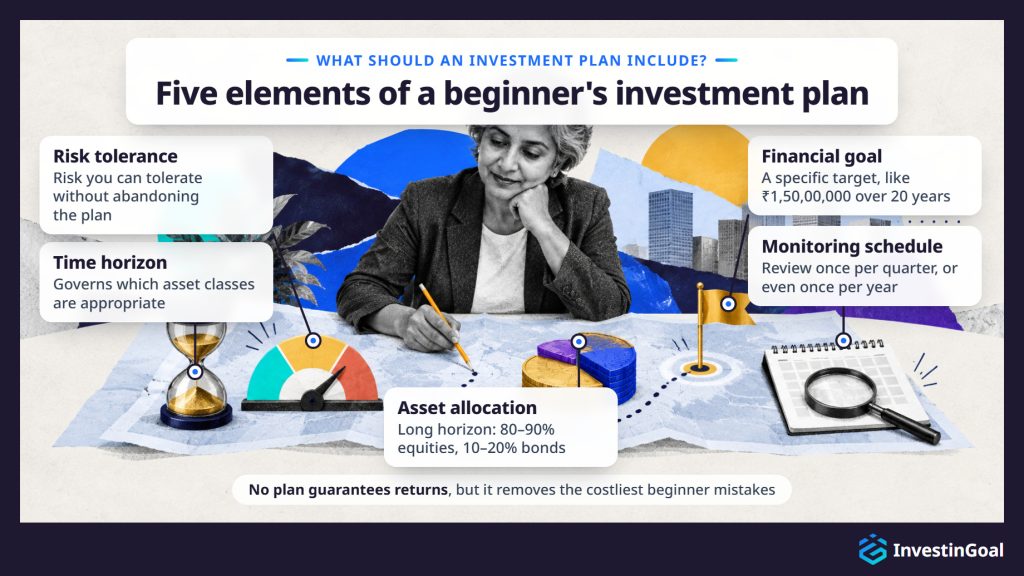
A complete investment plan for a beginner should include five elements: a clearly stated financial goal, a defined time horizon, an honest assessment of risk tolerance, an initial asset allocation that reflects all three, and a monitoring schedule to review progress without overreacting to short-term price changes.
- The financial goal is the anchor. “Grow my money” is not a goal. “Accumulate ₹1,50,00,000 over 20 years for retirement” is. A specific target lets you calculate the required monthly contribution, choose the appropriate risk level, and measure whether you are on track.
- The time horizon governs which asset classes are appropriate. A 25-year retirement goal can tolerate significant equity exposure because there is time to recover from downturns. A 5-year goal requires a more conservative allocation because the window for recovery is narrow.
- Risk tolerance is the element that connects time horizon and asset allocation in practice. It is not just about how much risk you can afford to take (which is a function of your financial situation) but how much risk you can psychologically tolerate without abandoning the plan. An honest self-assessment of risk tolerance prevents the most common failure mode: building a portfolio that is theoretically optimal but behaviourally unsustainable.
- Asset allocation translates the goal, the time horizon, and the risk tolerance into a specific mix of investments. A common starting point for a beginner with a long time horizon is 80–90% equities (via index funds) and 10–20% bonds, adjusted as the goal date approaches.
- The monitoring schedule sets a review frequency that prevents both neglect and overreaction. Checking your portfolio once per quarter, or even once per year, is sufficient for a long-term plan. Daily monitoring encourages emotional decision-making and is one of the most reliable paths to panic selling.
A plan built on these five elements does not guarantee returns. It does remove the three most costly beginner mistakes that a missing investment plan causes: investing without a target, choosing assets that do not match the time horizon, and abandoning the strategy during a downturn because the emotional cost of holding became unbearable.
Beginners are best served by two complementary strategies: passive index investing through low-cost funds, which removes the need for active stock selection, and a regular contribution schedule, often called rupee-cost averaging, which removes the need to time the market. Both strategies suit beginners, because neither needs market knowledge to work.
Passive index investing means buying a fund that tracks a broad market index and holding it. You are not trying to pick the best stocks or predict which sectors will outperform. You are accepting the market’s average return, which has historically been 7–10% a year over long periods. The simplicity is deliberate, because fewer decisions mean fewer opportunities for costly mistakes.
Rupee-cost averaging means investing a fixed amount at regular intervals, regardless of whether the market is up or down. When prices are high, your fixed contribution buys fewer shares. When prices are low, it buys more. Over time, this smooths out the average purchase price and eliminates the risk of investing a large sum at the worst possible moment. The strategy works because staying out of market timing is the only realistic approach for most people.
Together, passive index investing and rupee-cost averaging require nothing more than choosing a fund, setting up an automatic contribution, and leaving the position to grow. Once a beginner has held a position through a full market cycle and has a clearer sense of their own risk tolerance and goals, more varied investing strategies become relevant.
For market-exposed investments, a minimum holding period of 5 years is the standard threshold below which the risk of selling at a loss increases substantially. Historically, broad indices such as the S&P 500 and the MSCI World Index have delivered positive returns in the large majority of 5-year periods, while shorter windows expose investors to a much wider range of outcomes. Beyond 5 years, the longer the holding period, the more time compound interest has to work, and the more short-term volatility becomes statistically irrelevant.
Over any single year, broad equity markets have historically produced negative returns roughly one year in four (based on major equity index data spanning nearly a century). Over any 5-year period, the frequency of negative outcomes drops significantly. Over 10-year and 20-year periods, negative outcomes become rare in diversified portfolios. This historical pattern is no guarantee, and it underpins the standard advice to invest only money you will not need for at least five years.
Beyond avoiding losses, time gives compound interest the cycles it needs to produce meaningful growth. A 30-year holding period produces far more than three times the return of a 10-year one, because each additional year compounds on a larger base. Each goal has its own investment time horizon, and retirement savings measured in decades need a different allocation from a medium-term target measured in 5–10 years.
What Account Do I Need to Start Investing?
To start investing, you need a brokerage account opened with a regulated broker or investment platform. A brokerage account holds financial assets such as stocks, ETFs, and funds on your behalf, and the broker uses it to execute your transactions in the market. Tax-wrapper accounts such as the UK's ISA may offer additional advantages, but India has no equivalent for buying shares.
A standard brokerage account is the default. It provides access to the full range of available investment products, and any gains are subject to the capital gains tax rules of your country. Opening one typically requires identity verification, a proof of address, and a few minutes of online form-filling.
Tax-wrapper accounts shelter some or all of your investment gains from tax in the countries that offer them. The specific rules depend entirely on your country of residence. Some countries, like the UK with its ISA accounts, offer an account of this kind. India has no equivalent for buying shares. These accounts often have annual contribution limits and specific rules about withdrawals.
For a beginner, the practical advice is to start with whatever account type is simplest to open and available on your chosen platform. In India that is the standard brokerage account. The account also decides which products you can hold, and some investment account types are only available through certain providers.
You choose the right investing platform or broker by checking five criteria: regulatory status and investor protection framework, range of available investment products, full fee structure including hidden costs, minimum deposit requirements, and platform usability. The first criterion is non-negotiable. A beginner should consider only platforms authorised by a recognised financial authority, such as the Securities and Exchange Board of India (SEBI) in India.
Regulatory status confirms that the platform operates under legal oversight, segregates client funds from company assets, and participates in an investor compensation scheme that provides a defined level of protection if the broker fails. Without this, no other feature matters. In India the investor compensation scheme is the Investor Protection Fund of each stock exchange, such as that of the National Stock Exchange (NSE).
Product range determines whether the platform offers what you need. At a minimum, a beginner needs access to low-cost global index funds or ETFs. Some platforms offer a wider range, with bonds, mutual funds, international ETFs, and options across dozens of markets. Interactive Brokers is one of them, and that range may become relevant as your knowledge grows.
Fee structure includes every charge, from trading commissions and custody fees to currency conversion, inactivity and withdrawal fees, and a beginner compares all of them. Some platforms advertise zero-commission trading but charge higher spreads or custody fees that offset the saving.
Minimum deposit requirements vary widely. Interactive Brokers sets no minimum, while other platforms may require tens of thousands or even hundreds of thousands of rupees. A beginner-friendly platform should allow you to start small and scale up as your confidence and capital grow.
Platform usability affects whether you actually maintain your plan. A platform that is confusing, slow, or poorly designed increases the friction of regular investing and makes you more likely to disengage.
The five criteria are the same for every provider, so they work best when applied side by side. That is how the comparison of the best online brokers uses them, provider by provider.